Objections
Net zero is one of the costliest decisions governments have ever made. A decision that big deserves hard questions, and so does every analysis of it, including this one. Here are the most common objections, short answers, and where to read more. Short answers can't settle every argument, but every number on this site is explained in the notes, and the data behind every number can be downloaded so you can check them yourself.
1.“Clean energy is cheaper now. Net zero will save money.”
Solar and wind are cheap when the sun shines and the wind blows, and the models already assume they keep getting cheaper. But when the sun isn't shining and the wind isn't blowing, keeping the lights on quickly gets very expensive. And net zero also means cutting everything that has little to do with electricity: steel, cement, flying, farming. If clean energy were already cheaper, current policies would already get us there. Of almost 1,000 model scenarios, all but 28 find a cost. Of those that cut emissions by at least 80%, 96% find it costs more than 1% of GDP in 2050. This site uses the middle one of the three that reach net zero starting from today's emissions.
2.“GDP isn't everything. What about lives and nature?”
Agreed, and that's why the avoided damages aren't just lost GDP. The damage studies count health, lives, species and ecosystems, and Nordhaus adds extra for what the studies leave out. And lost income isn't just money: almost everything we care about rises with income, including nature. Richer countries score much better on Yale's Environmental Performance Index, and as countries get richer they typically stop cutting down their forests and start growing them back.
3.“You make each country look pointless by slicing up a global problem.”
Saying what one country's net zero does isn't walking away from cooperation; it's doing the arithmetic. Cooperation that only works as long as nobody does the math won't last. And the site doesn't only slice: on the World page, the whole world goes net zero together. The world is 1.4°C cooler in 2100, but it costs $255 trillion in today's money for $24 trillion of benefit: 9 cents back per dollar.
4.“Discounting means caring less about our grandchildren.”
Even with no discounting at all, the world gets 17 cents back per dollar. And our grandchildren will almost certainly be much richer than we are. In every one of the 1,430 UN Climate Panel scenarios that project incomes, the average person in 2100 is richer than in 2020, typically more than four times richer, and in Sub-Saharan Africa about 17 times. As Nobel laureate Robert Solow put it:
“There is something inconsistent about people who profess to be terribly concerned about the welfare of future generations but do not seem to be terribly concerned about the welfare of poor people today.”
(Solow 1991) · More on discounting
5.“You ignore tipping points.”
They're in. Nordhaus adds 1% of GDP at 3°C for tipping points. And when economists actually measure them, the effects are smaller than the headlines suggest. The most comprehensive economic study so far, covering the eight tipping points in the economic literature, finds they raise the damage from each ton of CO₂ by about 25%, with a small chance of much more (Dietz et al. 2021). Nordhaus found that even with no climate policy at all, the melting of the Greenland ice sheet costs only about 0.01% of GDP in 2100 (Nordhaus 2019). Using only Nordhaus's higher damages, the world still only gets 12 cents back per dollar.
6.“Other studies show damages are far bigger.”
The best known, and the second most talked-about climate paper of 2024, claimed 19% lower income by 2050. It was retracted in 2025 because its errors were too large to correct. Others rest on shaky ground, such as a few unusual years of data, as the Benefits notes explain. The site uses the two standard summaries of the studies.
7.“Climate damage goes on for centuries. Stopping at 2100 is cheating.”
Stopping at 2100 is what most climate analysis does: the UN Climate Panel's scenarios, and the models behind them, mostly end there. And while the benefits of course continue after 2100, so do the costs: net zero still costs over 4% of GDP in 2100, against benefits under 2%. Nordhaus's own model, which counts damages for centuries, recommends far less than net zero by 2050.
8.“Economists always overestimate the cost of environmental policy.”
For climate policy, the estimates more likely understate the cost. Nine in ten of the model scenarios from the UN Climate Panel and later studies assume the cheapest possible policy: one carbon price everywhere. Real policies rarely work that way. When economists modeled the EU's 2020 climate targets as actually designed, the cost came out twice as high as with the cheapest policy, and four times the European Commission's own estimate (Böhringer, Rutherford, and Tol 2009). And because countries' carbon prices differed so much, climate policy in 2019 cost 2.6 times what the cheapest policy would have (Tol 2023).
9.“Green investment creates jobs and growth.”
It creates jobs and growth in green sectors, but less growth overall. A job isn't a benefit in itself; it is what it costs to produce something. When policy steers workers into more expensive energy, they could instead have been builders, shop assistants or taxi drivers, making other things people want, so society ends up poorer, not richer. That is what the models measure: not jobs, but how much the whole economy produces.
10.“Count the cleaner air too, and net zero pays for itself.”
Air pollution will fall dramatically even without any further climate policy: as countries get richer, they clean up their air. Under current policies, world sulfur pollution falls by a third by 2050 and two-thirds by 2100. Net zero's extra health gain is about 0.1–0.2% of world GDP: a real benefit, but nowhere near enough to tip the balance. And much of it could be had far more cheaply with targeted policies: scrubbers on power plants, catalytic converters, diesel particle filters and cleaner fuel standards for vehicles, and clean cooking stoves for the billions who still cook over smoky fires.
11.“Net zero gives us energy security.”
It gives us both more and less energy security (Böhringer and Bortolamedi 2015). Less imported oil and gas helps. But wind and solar bring new dependence: on backup, batteries and long power lines for when the sun doesn't shine and the wind doesn't blow, and on China, which makes most of the world's panels and batteries and refines most of the minerals in them. That's why Lithuania, the EU and the US are moving to restrict Chinese solar inverters, which can be controlled from abroad.
12.“Why trust Lomborg?”
You don't have to. Every number is clearly defined and originates in mainstream sources: the UN Climate Panel's scenario database, the climate model it uses, the new CMIP7 scenario, the cost model AIM, and two of the most respected summaries of climate damages, one of them by William Nordhaus, the only climate economist to win the Nobel Prize. Moreover, you can download the data behind every number and check it yourself.
About the site and the download
13.“So you're saying we should do nothing?”
No. Climate change is real, and smart climate policies can definitely be worthwhile. This site measures just one policy, net zero by 2050: the target the UN and its climate summits have been pushing for, and which about 140 governments have adopted in some form. It is also by far the most expensive policy ever proposed: about $255 trillion in today's money, hundreds of times the Marshall Plan or the reparations imposed on Germany after the First World War. A policy that big has to answer whether it is worth it. It turns out that net zero by 2050 costs far more than it delivers. That's why we should focus on smarter policies, above all research and development to make clean energy cheaper than fossil fuels, which does much more good per dollar (Lomborg 2020).
14.“OK, net zero is too expensive. But surely a smaller cut would be worth it?”
Almost never. The chart below shows the same scenarios as the cost page, each placed by how much it cuts emissions by 2050 and what that costs. For each scenario with full emission paths, its emissions and those of its reference scenario (the same model without the extra climate policy) are both run through the MAGICC climate model; scenarios from papers without full paths are judged on 2050 alone. The difference is the warming avoided, which is valued the same way as on the rest of this site. The color shows which way the scales tip: red where the costs outweigh the benefits, blue where the benefits outweigh the costs. 96% are red: they cost more than they deliver.
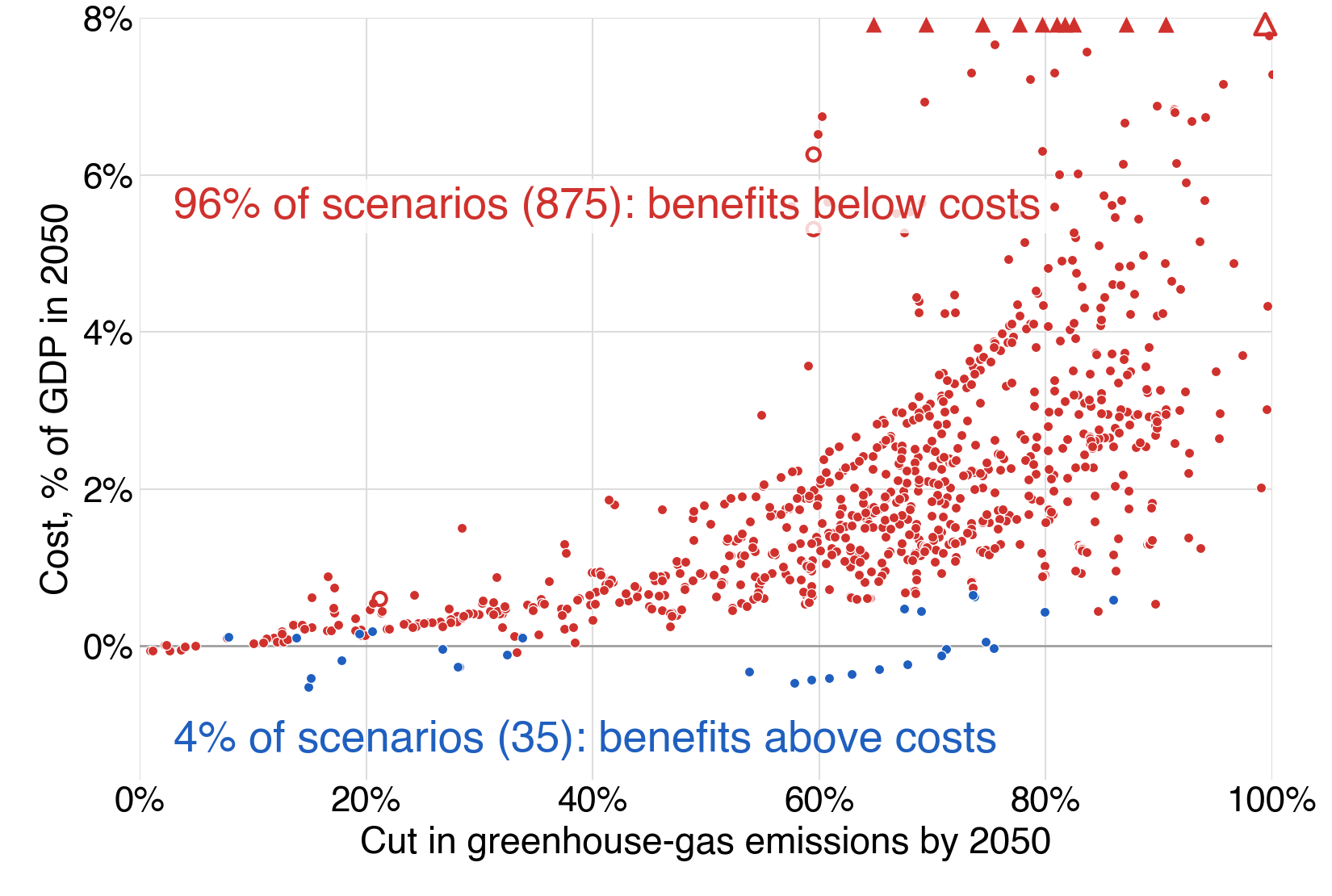
The few blue ones are cheap for one of two reasons. About half make only small cuts, and most of these come from one model, REMIND, which often finds climate policy cheap or almost free. When other models ran the very same scenarios, the costs came out several times higher, and they no longer paid off. Most of the rest assume that people make big changes in how they live and eat, without counting any of the cost of making these changes. Ten of them also assume that people simply save more in the climate scenario. That alone cancels about 40% of the cost of climate policy over the century, and all of it by 2100, even though saving more would raise GDP with or without the extra climate policy. The study behind these ten states its aim as “reducing or taking away climate change mitigation costs” (Fujimori et al. 2023). It also runs identical cuts without these assumptions: then they return only about 20 cents on the dollar.
That's why the smarter policy is to make clean energy cheaper through research and development, rather than paying for cuts that cost more than they deliver.
References
- Barrage, Lint, and William Nordhaus. 2024. “Policies, Projections, and the Social Cost of Carbon: Results from the DICE-2023 Model.” Proceedings of the National Academy of Sciences 121 (13): e2312030121. doi.org/10.1073/pnas.2312030121
- Böhringer, Christoph, and Markus Bortolamedi. 2015. “Sense and No(n)-Sense of Energy Security Indicators.” Ecological Economics 119: 359–71. doi.org/10.1016/j.ecolecon.2015.09.020
- Böhringer, Christoph, Thomas F. Rutherford, and Richard S. J. Tol. 2009. “The EU 20/20/2020 Targets: An Overview of the EMF22 Assessment.” Energy Economics 31: S268–73. doi.org/10.1016/j.eneco.2009.10.010
- Byers, Edward, et al. 2022. “AR6 Scenarios Database.” IIASA and Zenodo. doi.org/10.5281/zenodo.5886911
- Dietz, Simon, James Rising, Thomas Stoerk, and Gernot Wagner. 2021. “Economic Impacts of Tipping Points in the Climate System.” Proceedings of the National Academy of Sciences 118: e2103081118. doi.org/10.1073/pnas.2103081118
- Fujimori, Shinichiro, Ken Oshiro, Tomoko Hasegawa, Junya Takakura, and Kayo Ueda. 2023. “Climate Change Mitigation Costs Reduction Caused by Socioeconomic-Technological Transitions.” npj Climate Action 2: 9. doi.org/10.1038/s44168-023-00041-w
- Lomborg, Bjorn. 2020. “Welfare in the 21st Century: Increasing Development, Reducing Inequality, the Impact of Climate Change, and the Cost of Climate Policies.” Technological Forecasting and Social Change 156: 119981. doi.org/10.1016/j.techfore.2020.119981
- Meinshausen, Malte, Sarah C. B. Raper, and Tom M. L. Wigley. 2011. “Emulating Coupled Atmosphere-Ocean and Carbon Cycle Models with a Simpler Model, MAGICC6 – Part 1: Model Description and Calibration.” Atmospheric Chemistry and Physics 11: 1417–56. doi.org/10.5194/acp-11-1417-2011
- Nordhaus, William. 2019. “Economics of the Disintegration of the Greenland Ice Sheet.” Proceedings of the National Academy of Sciences 116: 12261–69. doi.org/10.1073/pnas.1814990116
- Solow, Robert M. 1991. “Sustainability: An Economist's Perspective.” The Eighteenth J. Seward Johnson Lecture. Woods Hole, MA: Woods Hole Oceanographic Institution. PDF (reprint)
- Tol, Richard S. J. 2023. “Costs and Benefits of the Paris Climate Targets.” Climate Change Economics 14: 2340003. doi.org/10.1142/S2010007823400031
- Tol, Richard S. J. 2024. “A Meta-Analysis of the Total Economic Impact of Climate Change.” Energy Policy 185: 113922. doi.org/10.1016/j.enpol.2023.113922